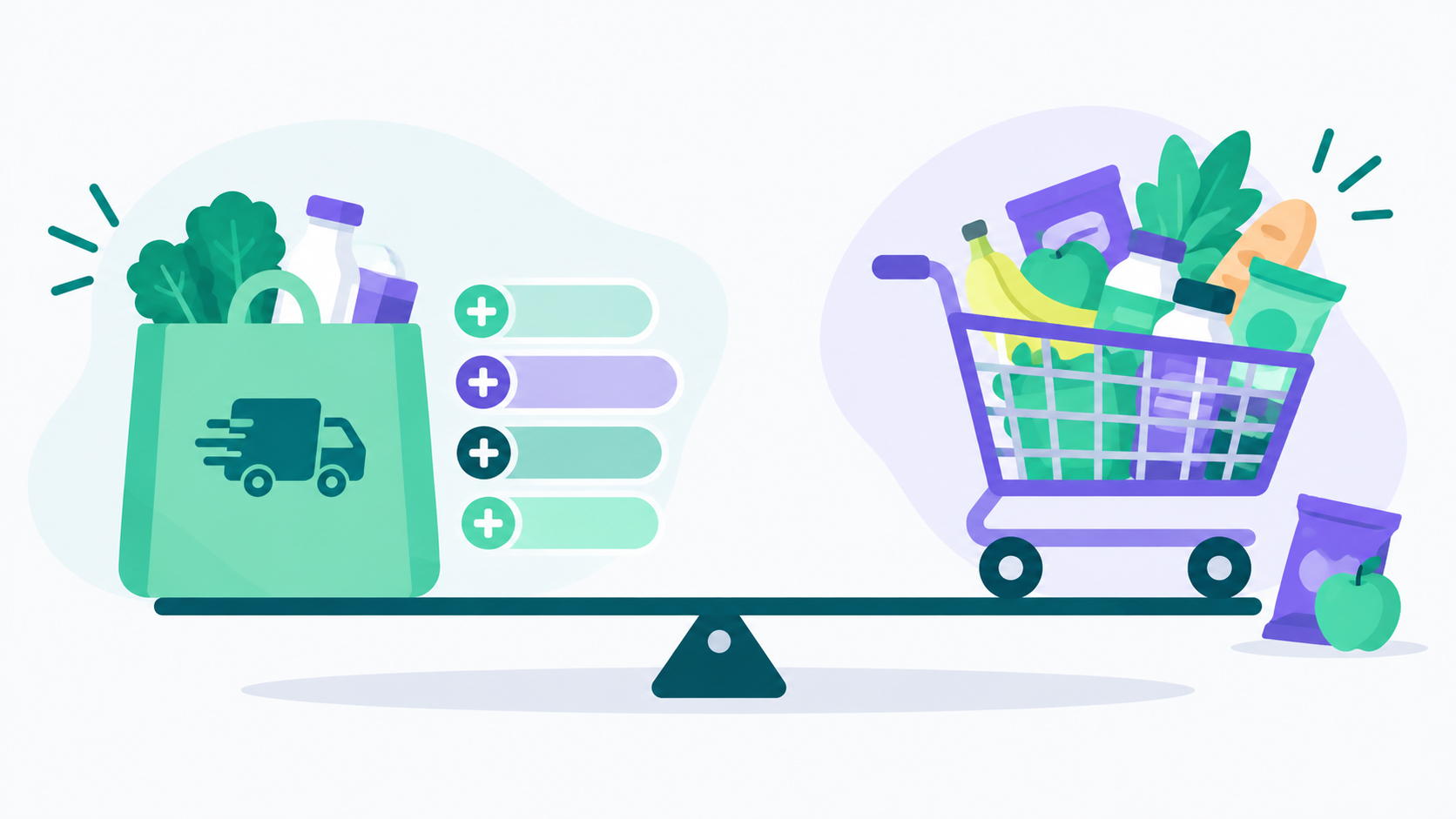
Grocery delivery costs more per basket, usually somewhere between $10 and $25 extra per order once you stack item markups, a delivery fee, a service fee, and a tip. Shopping in person costs less on the receipt and more in unplanned purchases, and for some households that second number is larger than the first.
So the honest answer is that it depends on you, specifically on how much you add to the cart when you're standing in the store. This post covers what each side actually costs, how to measure your own number in two weeks, and when each option genuinely wins.
What does grocery delivery actually add to your bill?
Four separate layers, and only one of them is the delivery fee. Item markups come first, then the delivery fee, then a service fee, then the tip, and they stack on top of each other rather than replacing one another.
Start with the item prices, because this is the layer most people don't realize exists. Some retailers pass through their in-store shelf prices on delivery platforms, and some let the platform set higher prices that build margin into the item cost itself. On Instacart, retailers offering shelf pricing display an in-store prices badge, so it's visible if you look. There's no general price match guarantee across the platform.
The fee layers come next. Instacart's own guidance says the delivery fee varies by retailer, delivery window, and order total, and that no single universal fee schedule exists. Faster or narrower windows cost more, stores flagged as farther away can carry a long distance fee, and orders below a threshold trigger small order surcharges. The service fee is separate and funds platform operations, and a membership that waives delivery fees does not generally waive service fees.
Then the tip, which most people set somewhere between 10 and 20 percent.
How much does that come to? Independent nonprofit Consumers' Checkbook found in test shopping that markups and fees added $40 or more to some orders. Be skeptical of any article quoting a single national average markup percentage, though, since the figure varies enormously by retailer, region, and basket, and several of the numbers circulating online don't trace to a real study. Your own receipts are the only reliable source here.
Does shopping in person actually cost less?
Not automatically. The receipt is lower, but a store visit carries costs the receipt never shows: unplanned purchases, fuel or transit, and your time.
Impulse spending is the big one. Capital One Shopping's research puts average unplanned purchases at roughly ten a month at about $26 each, and grocery stores are engineered specifically to produce them. Endcaps, checkout displays, the bakery smell near the entrance, and the layout that routes you past everything to reach milk are all deliberate. None of that reaches you through an app.
Add the trip itself. A 20 minute round trip in a car costs a few dollars in fuel and wear, and the trip takes 45 to 90 minutes door to door once you factor parking, shopping, and unloading. Whether that time has a dollar value depends on your situation, and it isn't zero for anyone.
Here's the part worth sitting with. If you reliably add $30 of unplanned items to every in-store trip, and delivery adds $18 in markup and fees, delivery is cheaper for you. That's not a rationalization, it's arithmetic, and it flips the conventional wisdom for a meaningful number of households.
How do you find your own number?
Run a two week test and log both sides. Place one delivery order and take one in-store trip with comparable baskets, then compare the all-in totals rather than the item subtotals.
Do these three things and the answer becomes obvious.
Match the basket, not just the receipt
Compare the same brands, same pack sizes, same store. A different pack size or a substituted brand creates a fake markup that isn't really there, which is the most common error in these comparisons. If a substitution happens on the delivery order, note it and adjust rather than counting it as a price difference.
Count everything in the trip
For the in-store trip, add the fuel or transit fare and, importantly, list every item that wasn't on your list. That second number is the one this whole exercise is really about, and most people are surprised by it.
For the delivery order, add the item subtotal, delivery fee, service fee, any surcharges, and the tip. The total at checkout is the number, not the subtotal.
Compare over a month, not a single trip
One of each isn't enough, because a single trip can be atypical. Run four weeks with a mix of both and compare monthly totals. Delivery also tends to suppress trip frequency, which matters: three delivery orders a month with fees may still beat eight quick in-store runs that each pick up something unplanned.
When does delivery actually win?
It wins when the fees are smaller than what a store trip costs you in unplanned spending, time, or logistics. A few situations where that's reliably true.
Large or heavy orders, where the per order fee spreads across a big basket and you avoid hauling twelve bags. Households without a car, where the alternative is a taxi or a long transit trip with groceries. People who work hourly and would otherwise give up a shift, where the math is straightforward. Anyone with a mobility limitation, a health condition, or small children, where the trip carries a real cost that has nothing to do with money.
And impulse prone shoppers, honestly. If you know your in-store trips reliably run $40 over the list, the app's inability to tempt you is worth paying for.
Retailer choice matters too. Ordering from a store that passes through shelf prices removes an entire layer, and some retailers run their own delivery service at a flat fee with no item markup at all, which is usually cheaper than a third party platform.
When does shopping in person win?
For small top-up orders, for sales and markdowns, and for anything where you want to choose the specific item yourself.
Small orders are the clearest case, since flat fees and minimums dominate a $30 basket. Fifteen dollars of fees on a $30 order is a 50 percent premium, which no convenience justifies for most budgets.
Markdowns are the second case. Manager's specials, clearance racks, and reduced-for-quick-sale produce are largely invisible through an app, and they're where a lot of real grocery savings live. Store loyalty promotions sometimes apply differently on delivery platforms too, so check whether your discounts carry over.
Then there's produce and substitutions. Someone else picking your avocados produces a hit rate you may not love, and substitutions can quietly wreck a meal plan built around specific ingredients. That has a real cost: the EPA estimates household food waste runs about $728 per person a year, or $2,913 for a household of four, which is over 11 percent of a typical food budget. Ingredients you didn't want and won't use land straight in that number.
If meal planning is part of how you control food spending, our comparison of meal planning versus last minute shopping covers how ingredient overlap does most of the work, and substitutions are the thing most likely to break it.
How do you cut delivery costs without giving it up?
Several of these take one setting change and keep paying every order.
Use pickup instead of delivery when you can. Same time saved inside the store, same protection from impulse aisles, and it typically avoids the delivery fee entirely. This is the single biggest lever available.
Choose retailers that pass through in-store pricing, which removes the markup layer completely. Check for the badge before you build a cart.
Batch your orders to clear the free delivery threshold and avoid small order surcharges. Two orders a month at $150 beats five orders at $60.
Pick flexible delivery windows rather than the fastest one, since priority windows carry a premium.
Order from the nearer store to avoid long distance fees.
Do the membership math honestly before subscribing. If a membership costs $99 a year and waives roughly $8 in delivery fees per order, it pays off around twelve orders. Below that it's a loss, and it doesn't waive service fees anyway.
How do you track this so you actually know?
Split groceries into separate subcategories for in-store and delivered, and give delivery fees and tips their own line. Keeping the fees separate from the food is the whole trick, because a single grocery total makes the comparison impossible.
Here's what that structure shows you that a lumped number can't. Your food cost and your convenience cost move independently. If groceries hold steady at $600 a month while fees climb from $22 to $71, you've learned something specific and actionable, which a flat "groceries went up" never tells you.
Most budgeting apps give you one preset grocery category and expect that to be enough. Lucky Friday lets you create unlimited custom categories and subcategories with your own icons and colors, so you can build a Food parent with groceries in-store, groceries delivered, delivery fees and tips, and restaurants underneath, and read both the total and the split. That's on the permanently free tier, with no category limits and no credit card required.
Two features make the tracking hold up over time. Category rules let you set a keyword once per merchant so orders file themselves rather than needing manual sorting every week. And the monthly and annual toggle matters here, because $18 in fees per order reads as trivial while $54 a month, or $648 a year, prompts an actual decision. If you'd rather have transactions import automatically than enter them yourself, bank sync through Plaid is available on the premium plan.
Give it 60 days before drawing conclusions, then look at direction rather than any single month. And whatever you find, assign the difference somewhere specific the same day, because money without a destination reabsorbs into other spending within a few weeks. Our guide to starting an emergency fund when you're already behind covers where to send it.
Common Questions About Grocery Delivery vs Shopping In Person
Is grocery delivery more expensive than shopping in store?
Per basket, usually yes, since delivery stacks item markups, a delivery fee, a service fee, and a tip. Independent test shopping has found markups and fees adding $40 or more to some orders. Whether it costs you more overall depends on how much you add to the cart on in-store trips, which for many people runs $20 to $40 per visit.
How much does Instacart mark up prices?
It varies by retailer, and there's no single reliable average. Some stores pass through their in-store shelf prices and display a badge indicating that, while others let the platform set higher item prices. Be skeptical of articles quoting one national markup percentage, and compare a few of your own receipts against shelf prices instead.
Is grocery pickup cheaper than delivery?
Usually yes, and it's the most underused option. Pickup typically avoids the delivery fee while still keeping you out of the aisles, which preserves most of the impulse protection that makes delivery worthwhile in the first place. Many retailers offer it free above a modest order minimum.
Does grocery delivery help you spend less overall?
It can, if you're prone to unplanned purchases in store. Research puts average impulse spending at roughly ten purchases a month at about $26 each, and grocery layouts are designed to produce exactly that. If you consistently overspend your list in person, the fees may cost less than the impulse buys they prevent.
Is an Instacart or delivery membership worth it?
It depends on your order frequency. A $99 annual membership waiving around $8 per order breaks even at roughly twelve orders a year, so weekly users come out ahead and occasional users don't. Memberships also don't generally waive service fees, so run the math on delivery fees alone.
Sources
Consumers' Checkbook test shopping on grocery delivery markups and fees, summarized at https://www.makemyreceipt.com/reports/food-delivery-statistics
Instacart fees and pricing guidance, as documented against Instacart's current Help Center. https://plottdata.com/blogs/instacart-fees-explained
Capital One Shopping Research. "Impulse Buying Statistics." https://capitaloneshopping.com/research/impulse-buying-statistics/
U.S. Environmental Protection Agency. "Estimating the Cost of Food Waste to American Consumers." 2025. https://www.epa.gov/system/files/documents/2025-04/costoffoodwastereport_508.pdf
U.S. Bureau of Labor Statistics. "Consumer Expenditures in 2024."