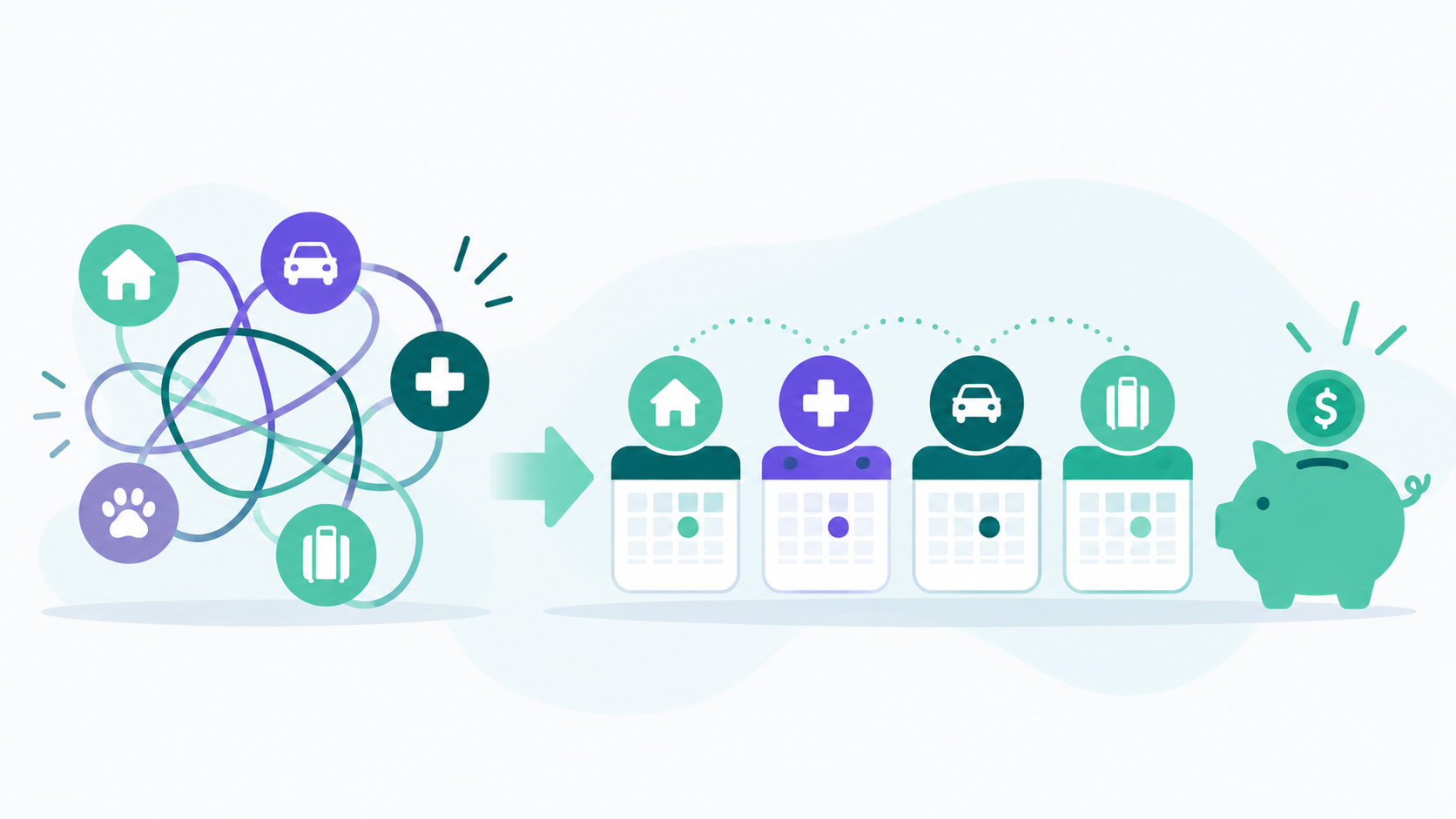
You stop worrying about money by converting open questions into scheduled decisions. Worry is what an unresolved risk does when it has nowhere else to go, so the fix isn't to think about it less, it's to give each risk a name, a number, a monthly amount, and a review date. Then you're allowed to stop thinking about it until that date.
That's the whole method, and it's less about discipline than about structure. Bankrate's Money and Mental Health Survey found that 43 percent of U.S. adults say money negatively affects their mental health at least occasionally, making it the single biggest reported factor, ahead of politics and world news at 38 percent and personal health at 36 percent. A large share of that isn't caused by the amount in the account. It's caused by not knowing what the amount needs to be.
Why does money worry feel constant?
Because an unresolved risk has no natural stopping point. A thought that ends in a decision closes. A thought that ends in "I don't know" loops back and reopens at 2 a.m., and it will keep doing that indefinitely because your brain treats an unfinished question as unfinished business.
Notice what the survey data points at. Bankrate found that 57 percent of people whose mental health is affected by money cite insufficient emergency savings specifically. Not debt, not income, not the market. The gap between what might happen and what they'd have available for it.
There's also a feedback loop worth naming. That same research found that people who say money is affecting their mental health are three times more likely to have paid a bill late in the past month than people who don't, at 22 percent versus 7 percent. Worry produces avoidance, avoidance produces a late fee, and the late fee produces more worry. Breaking that loop matters more than any individual dollar amount.
So the useful reframe is that money anxiety is often an information problem wearing the costume of a character problem. You're not worrying because you're bad with money. You're worrying because a question is open.
What's the difference between planning and worrying?
Planning is bounded and ends in an action. Worrying is unbounded and ends in more worrying. The test is simple: if the thought produces a decision, it was planning. If it produces the same thought again tomorrow, it was worry.
Here's the practical version. "What if the car breaks down?" is worry. "A transmission repair runs about $3,500, I have $600 saved, so I'm putting $75 a month into a car fund and I'll check it in June" is planning. Same underlying risk, completely different mental weight, and the difference took about four minutes to produce.
Three questions convert one into the other every time.
What specifically am I afraid of? Vague dread resists solutions. Name the actual event.
What would it cost, roughly? Not exactly. A number within a few hundred dollars is enough to plan against, and looking it up takes ten minutes.
What's the next single action? Not the full solution, just the next step. Usually that's setting up a transfer or making one phone call.
The reason this works is that your brain will keep raising an issue until it's satisfied the issue is handled. A scheduled review date satisfies it in a way that "I'll deal with it eventually" never does.
How do you plan for the unexpected without obsessing over it?
Run through five steps once, then let the system run. The whole exercise takes about an hour, and the point is that it's finite.
List only the plausible risks
Write down the things that could realistically hit your finances in the next two years. Car trouble, an appliance dying, a medical bill, a pet emergency, a reduction in hours, a family member needing help. Keep it to things with a genuine chance of happening to you specifically.
Deliberately leave off the catastrophic and the improbable. Not because those things can't happen, but because they aren't what a savings plan solves, and putting them on this list is how a planning exercise turns into a spiral.
Size each one roughly
Look up real numbers. A local mechanic can tell you what a common repair costs on your car. Your insurance documents list your deductible and out-of-pocket maximum. Ten minutes of searching gives you a workable figure for each item.
Estimating is the step people skip, and skipping it is what keeps the fear unbounded. An unknown number is infinitely large in your imagination. A known number is $2,400, which is a lot but is also finite and therefore plannable.
Cover the cheapest and likeliest first
Rank by how likely something is multiplied by what it costs, then start at the top. The small, frequent stuff (a $600 repair, a $300 vet visit) is what actually happens to most people in a given year, and covering it removes the majority of your realistic exposure for a fraction of the money.
Assign a monthly amount and automate it
Divide your first target by twelve and set an automatic transfer for the day after payday. Automating matters here beyond convenience, because a transfer that happens without your involvement is a promise you can't fail to keep, and each successful month reduces the background hum a little further.
Schedule the review, then genuinely stop
Pick two dates a year, put them in your calendar, and give yourself explicit permission to not think about any of this in between. The scheduled review is what makes the permission credible. Without it, "I'll stop worrying" is just an instruction you can't follow.
Which risks are worth savings, and which need insurance?
Match the tool to the risk. Savings handles things that are likely and moderately expensive. Insurance handles things that are unlikely and catastrophically expensive. Trying to save your way out of a risk that only insurance can cover is a reliable source of unnecessary dread.
That distinction resolves a lot of anxiety on its own. You cannot build a savings fund large enough to cover a serious hospitalization, a house fire, or long term disability. Attempting it means permanently feeling behind, because the target is unreachable by design.
Savings territory covers car and home repairs, appliance replacement, deductibles, vet bills, travel for a family emergency, and a few months of income. That's the list your monthly transfers are for.
Insurance territory covers major medical events, liability, home or rental losses, disability, and life coverage if someone depends on your income. Reviewing whether those are in place is a one time task, and once it's done, those risks come off your worry list entirely rather than sitting there unfunded.
Some things fall in between, and honestly a few risks just can't be fully covered by either. Accepting that a small residual exposure exists is part of the process, and it's more restful than pretending you can eliminate it.
What does "enough" actually look like?
Less than you think, at least for the first meaningful improvement. Urban Institute research found that families with as little as $250 to $749 in savings were less likely to be evicted or miss a housing or utility payment after a job loss, health issue, or income drop.
That threshold is worth knowing because the standard advice sets a target so distant it produces the opposite of calm. Six months of expenses for a household spending $3,500 a month is $21,000, and at $100 a month that's seventeen years. No one feels reassured by a seventeen year plan.
The tiered version works better. Roughly $500 covers most fee cascades and small repairs. Around $1,000 handles the majority of single unexpected expenses, and Bankrate's January 2026 report found only 30 percent of Americans would cover a $1,000 emergency from savings, so crossing that line puts you in a minority. One month of expenses buys you decision time, which is the thing that changes outcomes during a real disruption.
For context on where most people sit, the Federal Reserve's 2025 Survey of Household Economics and Decisionmaking found that 63 percent of adults could cover a $400 emergency expense with cash or its equivalent, and 55 percent had three months of expenses set aside. Our guide to starting an emergency fund when you're already behind walks through building that first tier when the budget looks like it has no room in it.
How do you stay aware without checking constantly?
Review monthly, not daily. Daily balance checking produces noise rather than information, and for a lot of people it becomes a compulsion that feeds the anxiety it was meant to relieve.
Here's what makes a monthly review actually reassuring rather than stressful. You need to see progress, not just position. A bank balance moves for a dozen unrelated reasons and tells you very little. A category that's filled from $200 to $650 over five months tells you the system is working, which is the specific piece of information that quiets the worry.
Lucky Friday lets you create unlimited custom categories and subcategories, so you can build a separate line for each risk you identified: car repair, medical, pet, home. Each one gets its own target and its own progress, and watching those fill is considerably more motivating than watching a single savings number. That's included on the permanently free tier, with no category limits and no credit card required. The annual budget view is worth using for this, since these funds make far more sense across twelve months than within one.
Two practical notes. Category rules let transactions file themselves so the review stays short, which matters because a review that takes an hour is a review you'll start skipping. And if you'd rather transactions import automatically instead of entering them by hand, bank sync through Plaid is available on the premium plan.
One honest caveat about tracking apps in general. They can become another thing to check compulsively, and that's worth watching for in yourself. If you notice you're opening the app several times a day and feeling worse each time, the useful move is to set a fixed cadence and stick to it, not to look more often. If you've tracked diligently before without your savings actually moving, our piece on why most budgeting apps never move your savings rate covers why visibility needs an automatic transfer behind it.
And if money worry is regularly costing you sleep or affecting your relationships, that's worth talking to someone about. Nonprofit credit counseling agencies offer free or low cost sessions, and financial stress is a legitimate thing to bring to a therapist. Neither is a sign anything has gone wrong with you.
Common Questions About Planning for the Unexpected
How do I stop worrying about money all the time?
Convert open questions into scheduled decisions, because an unresolved risk has no natural stopping point. Name the specific thing you're afraid of, look up roughly what it would cost, assign a monthly amount toward it, and put a review date on the calendar. The review date is what makes it credible to stop thinking about between reviews.
How much emergency savings do I need to feel secure?
The first meaningful improvement comes much earlier than most advice suggests. Urban Institute research found measurably better outcomes for families holding just $250 to $749 compared with those below that. Aim for $500, then $1,000, then a month of expenses, rather than treating six months as the point where benefits begin.
What's the difference between planning and worrying about money?
Planning is bounded and ends in an action, while worrying is unbounded and repeats. If a thought produces a decision, it was planning. If the same thought returns tomorrow unchanged, it was worry, and the fix is usually a missing number rather than more willpower.
Should I save for a disaster or buy insurance?
Match the tool to the risk. Savings covers likely, moderately expensive events like car repairs, deductibles, and appliance replacements. Insurance covers unlikely but catastrophic events like major medical costs, disability, and property loss, which no realistic savings plan can cover. Trying to save against a catastrophic risk creates permanent anxiety because the target is unreachable.
How often should I check my finances?
Once a month is enough for most people, and daily checking usually produces anxiety rather than useful information. Pick a repeating date, look at what moved and how your funds are progressing, and leave it alone in between. If you find yourself checking several times a day and feeling worse each time, a fixed cadence helps more than more frequent looking.
Sources
Bankrate. "Survey: 43% of Americans say money is negatively impacting their mental health." Money and Mental Health Survey, conducted with YouGov Plc. https://www.bankrate.com/banking/money-and-mental-health-survey/
Bankrate. "Just 30% of Americans Say They Would Pay an Emergency Expense of $1,000 From Savings." January 21, 2026. https://www.bankrate.com/press-releases/just-30-of-americans-say-they-would-pay-an-emergency-expense-of-1000-from-savings/
Board of Governors of the Federal Reserve System. "Economic Well-Being of U.S. Households in 2025," Savings and Investments section, May 2026. https://www.federalreserve.gov/publications/2026-economic-well-being-of-us-households-in-2025-savings-investments.htm
Urban Institute. "Why Cities Should Care about Family Financial Security."