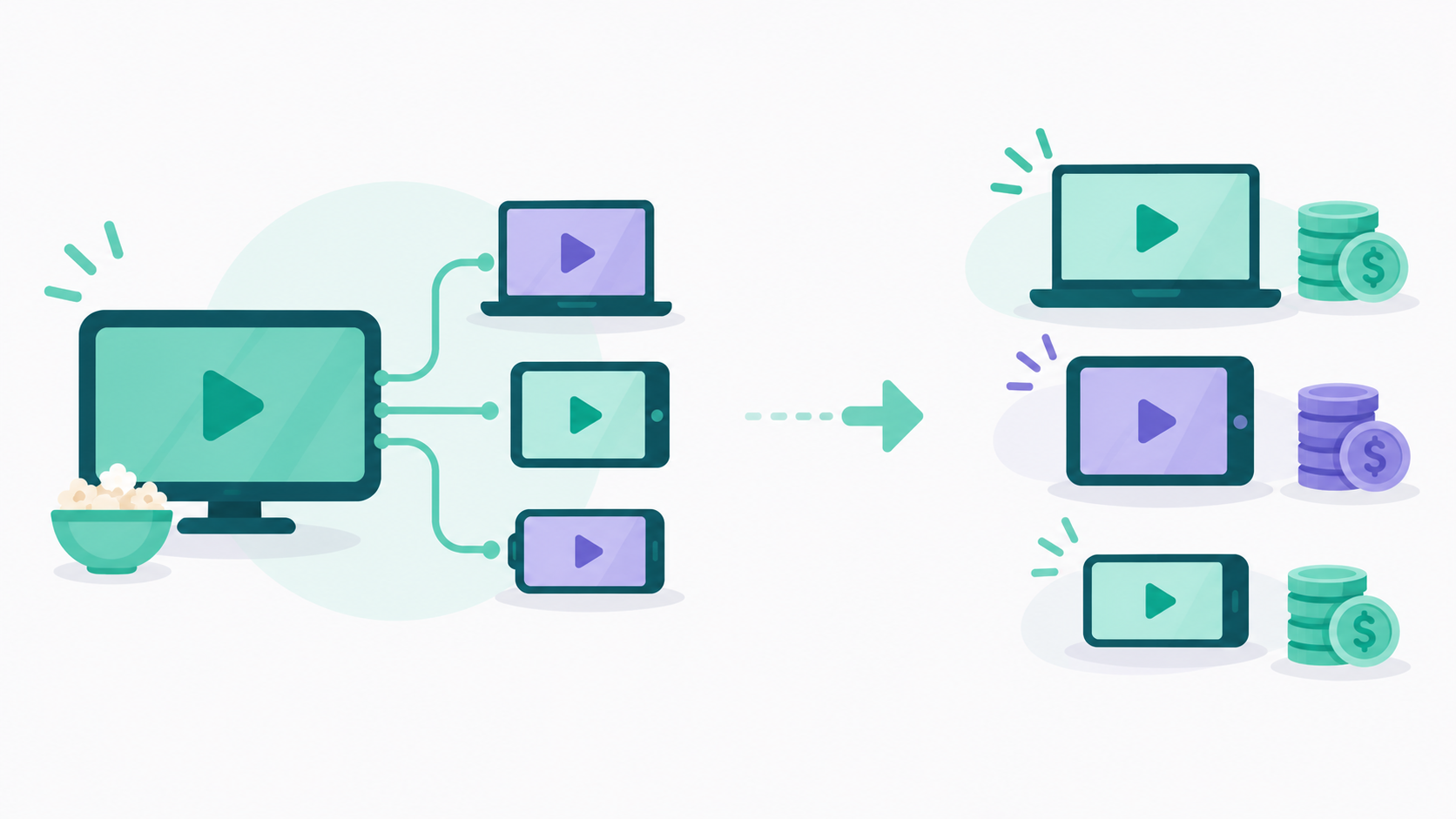
The extra member fee is not the real cost of a password sharing crackdown. The real cost is what happens after: one shared account that three people split informally becomes three separate subscriptions, and the combined household spend across everyone involved roughly triples while nobody sits down and runs the arithmetic.
Streaming is also the category people track worst, which is what makes this expensive quietly rather than obviously. Deloitte's 2026 Digital Media Trends survey found that the average subscribing U.S. household pays for four streaming services at a combined $69 a month, and that figure has held flat for a year. What moves underneath it is the composition, and composition changes are exactly what a crackdown forces.
What is a streaming password sharing crackdown, exactly?
It's a policy limiting an account to one household, where "household" is determined by the devices connecting to the internet at the account's primary viewing location. It isn't a list of who knows the password, and it isn't a postal address rule.
Netflix set the template starting in 2023, when the company said more than 100 million households were sharing accounts. It uses a combination of IP addresses, device IDs, and account activity to determine which devices belong to the household. People who live at that address can watch anywhere, including while traveling, though verification codes sometimes get requested.
Current U.S. pricing matters for the math below. After the March 2026 price increase, Netflix Standard runs $19.99 a month and Premium runs $26.99, with an extra member slot costing $7.99 with ads or $9.99 without. Standard supports one extra member and Premium supports two, while the ad supported Standard tier can't add extra members at all. Extra members also have to activate in the country where the primary account was created, which rules out the common arrangement of covering a relative overseas.
Here's the part most coverage gets wrong, though. Enforcement across the industry is uneven. As of 2026, some services genuinely police the household rule, some wrote one into their terms and never enforced it, and a few haven't bothered. So "the crackdown" isn't one event, it's a rolling set of individual company decisions, which is why your accounts get disrupted one at a time over years rather than all at once.
What does a crackdown actually cost you?
Usually two to three times what the shared arrangement cost, spread across the people who were sharing. The fee you get quoted covers one slot. The expense that actually shows up is the unbundling.
The split account arithmetic
Run a realistic scenario. Three adults, an account holder plus two people elsewhere, splitting one Premium plan at $26.99. That's about $9 each per month, or $108 a year per person.
Now the household rule lands. The account holder keeps Premium at $26.99. The other two each start a Standard plan at $19.99. Combined monthly spend across the three people goes from $26.99 to $66.97, and annually from $324 to $804. Nobody's viewing habits changed. The bill went up roughly $480 a year across the group, and because it's split across three separate bank statements, no single person experiences it as a $480 increase.
The extra member route is cheaper on paper. Two extra slots at $7.99 with ads on top of Premium is $42.97 a month, or $516 a year, which beats $804. That option requires the account holder to absorb the billing and then collect from two people every month, which is its own ongoing problem.
The ad tier downgrade is a real cost
The most common response to a price increase isn't cancellation, it's downgrading. Deloitte found that 68 percent of U.S. streaming subscribers now pay for an ad tier, up sharply from 54 percent in 2024 and 46 percent the year before.
That's a rational trade and worth naming for what it is. You keep the dollar cost flat by paying in attention and viewing data instead. Not a bad deal necessarily, just not a saving in the way the flat monthly number suggests.
The quiet re-subscribe
This is the one that does the most damage over time. Someone gets cut off, subscribes on their own, watches one series, and then keeps paying for eight months without opening the app again. Self Financial's 2026 survey found that nearly 60 percent of people have at least one unused subscription in a typical month, averaging 2.6 unused subscriptions, up from 54.9 percent and 0.8 unused the year before.
The re-subscribe feels like a small decision because it happens at $19.99. It becomes a $240 annual line item that outlives the reason it was created.
Why is streaming the hardest spending category to see?
Because the charges are small, automatic, spread across multiple dates, and often billed under merchant names that don't match the service. There's no checkout moment to notice and no monthly decision to reconsider.
The churn data shows how much movement is happening under a flat total. Deloitte's survey put annual churn among streaming subscribers at roughly 40 percent, with 41 percent of consumers reporting they had canceled at least one service in the past six months and 47 percent saying they had too many. So the average household's $69 is not four stable subscriptions. It's a rotating set that changes several times a year, which is exactly the pattern that defeats memory based tracking.
Price sensitivity is real, too. Deloitte found that 73 percent of subscribers are frustrated by continued price increases, and 61 percent said they would cancel their favorite service over a $5 monthly increase. People clearly care about this spending. They just can't see it in aggregate, and caring about a number you can't see doesn't change behavior.
How do you decide what to do when a shared account ends?
Work out cost per hour watched before you decide anything, then rotate rather than stack. Most people default to replacing the shared access with an individual subscription, which is the most expensive option available and rarely the one they'd choose after doing the math.
Calculate cost per hour
Take the monthly price and divide by the hours you actually watched last month. A $19.99 service you watched 20 hours is a dollar an hour, which is cheap entertainment. The same service watched three hours is $6.66 an hour, which is more than a matinee ticket per hour of half attention while you scroll your phone.
Check your viewing history rather than estimating. Estimates on this run consistently high, in the same direction as every other spending estimate.
Rotate instead of stacking
Subscribe to one service at a time, watch what you want, cancel, move to the next. Nearly all of them are month to month with no penalty. Four services at $17 average is $816 a year. One service at a time, rotated quarterly, is roughly $204. That's a $600 difference for content you'd mostly consume sequentially anyway.
The reason people don't do this isn't ignorance, it's friction: canceling takes five minutes and remembering to cancel takes attention. Put the cancellation date in your calendar the day you subscribe, and the friction problem mostly solves itself.
Decide about the ad tier on purpose
If you're going to downgrade, downgrade deliberately rather than as a reflex. Deloitte found consumers consider about $10 a month the right price for an ad supported service and $14 for ad free, with anything above $25 seen as too expensive. Compare your service against those anchors and decide whether the ad free premium is worth roughly $70 to $120 a year to you.
Have the family conversation with an actual number
Crackdowns force money conversations between parents and adult children, ex partners, and siblings that never had to happen before. Those go better with a number attached. "I'm keeping Premium, an extra slot is $7.99 a month, want me to add you and you send me $8?" is a much easier conversation than a vague sense that someone owes someone something. Whoever fronts the money should set a collection expectation up front rather than chasing it later.
How do you track subscriptions so this doesn't creep back?
Give subscriptions their own category, with a subcategory per service, and look at the annual number rather than the monthly one. Monthly figures are individually forgettable by design. Annual figures aren't.
That reframing does most of the work. Four services at $69 a month is $828 a year, and $828 is a number people actually have opinions about. A single $19.99 charge is not.
Here's where the structure matters. Lumping streaming into a broad "Entertainment" category tells you the total moved without telling you which service caused it, which is useless when the whole problem is composition change. Lucky Friday lets you create unlimited custom categories and subcategories with your own icons and colors, so you can build a Subscriptions parent with a subcategory per service and read both the total and the breakdown. When one gets canceled and another appears, the change is visible immediately rather than at the end of a year. That's all on the permanently free tier, with no category limits and no credit card required.
A few things that make the tracking stick:
Scan three months of statements, not one, since annual and quarterly billing won't show up in a single month. This is also how you catch services billing under a parent company name you don't recognize.
Set category rules so streaming charges file themselves automatically instead of requiring manual sorting every month. Whoever fronts a shared account should also log the reimbursements, since money going out and coming back at different times distorts the category totals in both directions.
Use the annual budget view, not just the monthly one. Toggling to the yearly figure is the single most effective thing you can do with subscription tracking, because the yearly number is the one that prompts a decision. If you'd rather have transactions import automatically rather than entering them, bank sync through Plaid is available on the premium plan.
Then do something with whatever you cut. Dropping from four services to two frees roughly $400 a year, and money without an assignment reabsorbs into something else within a couple of months. Our guide to starting an emergency fund when you're already behind covers where to send it, and if you've tracked spending before without your savings changing, our piece on why most budgeting apps never move your savings rate explains the gap between noticing a number and acting on it.
Common Questions About Password Sharing Crackdowns
How much does it cost to add someone outside my household on Netflix?
An extra member slot costs $7.99 a month with ads or $9.99 without in the U.S. as of 2026. Standard supports one extra member and Premium supports two, while the ad supported Standard tier can't add extra members at all. The account holder is billed for the slot, so you'll need to arrange repayment separately if you're splitting the cost.
Is it cheaper to add an extra member or have everyone get their own account?
Extra member slots are almost always cheaper in total. Two extra slots at $7.99 on top of a $26.99 Premium plan comes to about $516 a year, versus roughly $804 if two people each start their own $19.99 Standard plan. The tradeoff is that one person carries the billing and has to collect from everyone else.
Are all streaming services cracking down on password sharing?
No, and that's a common misconception. As of 2026 the picture is uneven: some services actively enforce household rules, some added household language to their terms without enforcing it, and others haven't addressed it. Policies change, so check the current terms of any specific service rather than assuming an industry standard exists.
How much does the average household spend on streaming?
About $69 a month across four paid services, according to Deloitte's 2026 Digital Media Trends survey of 3,575 U.S. consumers. That works out to $828 a year, and the figure has stayed flat while the mix of services changes underneath it. Annual churn among streaming subscribers runs around 40 percent.
How do I stop paying for streaming services I don't use?
Scan three months of bank statements rather than one, since quarterly and annual charges won't appear in a single month, then cancel anything you haven't opened in 60 days. Give subscriptions a dedicated budget category afterward so the total stays visible instead of scattered across a dozen billing dates. Nearly 60 percent of people have at least one unused subscription in any given month, so there's usually something to find.
Sources
Deloitte, "Digital Media Trends," 20th annual edition, survey of 3,575 U.S. consumers fielded October and November 2025, as reported by Variety. https://variety.com/2026/tv/news/how-much-us-households-spend-streaming-video-deloitte-study-1236694151/
Pocket-lint. "Who's still cracking down on password sharing in 2026, and who gave up." August 2026. https://www.pocket-lint.com/streaming-password-sharing-crackdown-2026/
PCWorld. "Are you sharing streaming passwords? Read this first." February 2026. https://www.pcworld.com/article/3071674/are-you-sharing-streaming-passwords-read-this-first.html
NPR. "Netflix has begun its plan to make users pay extra for password sharing." May 24, 2023. https://npr.org/2023/05/24/1177848004/netflix-password-sharing
Self Financial 2026 subscription survey data on unused subscriptions, summarized at https://termsandconditionstemplate.com/how-many-subscriptions-does-the-average-person-have