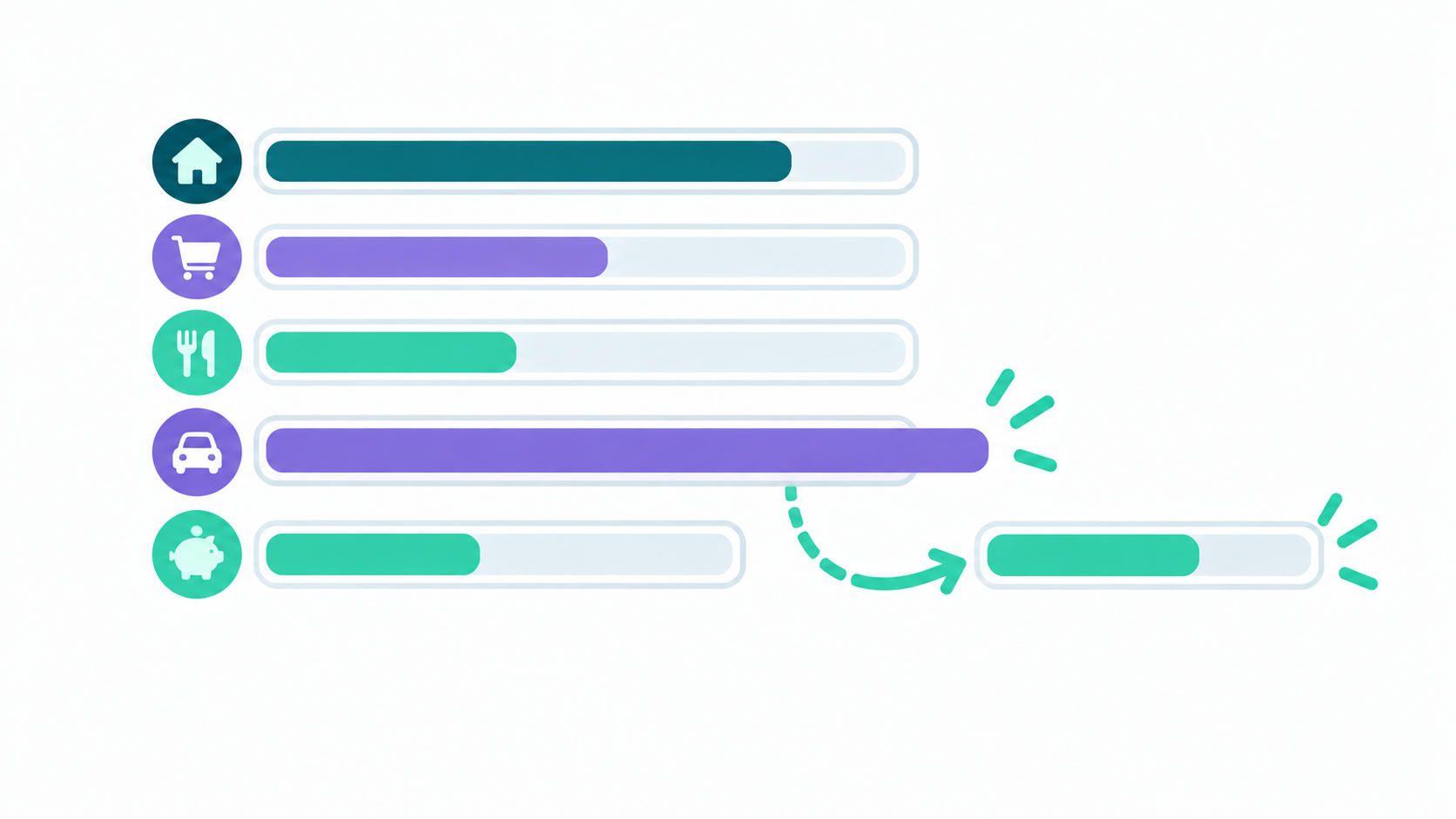
When you blow your budget, do three things: record what actually happened, work out which of four causes it was, and adjust the number going forward. What you shouldn't do is cut next month to compensate, or start the whole system over.
The reason those two responses are so damaging is that one overspent month rarely does much financial harm on its own. What ends budgets is the reaction to it. Research on everyday self-regulation has found that people are more likely to fail again after an initial failure, and the mechanism running underneath is how they explain the first one to themselves.
Why does one overspent month end so many budgets?
Because a single setback triggers a chain of thinking that makes the next one more likely. Researchers call this the setback effect, and the pattern is well documented across self-regulation domains.
Work published in the European Journal of Social Psychology identified three things that tend to happen after a lapse. Your sense of being able to do this drops. Your sense that the effort is even worth it drops. And you attribute the failure to something stable about yourself rather than to the situation.
That last one is the lever. Research on the abstinence violation effect found that when people attribute a lapse to stable, internal factors, meaning something about who they are rather than what happened, the chance of a full collapse rises sharply. Attribute the same lapse to circumstances and the plan, and it stays a lapse.
There's a related pattern with a memorable name. Winona Cochran and Abraham Tesser described the "what the hell effect," where breaking a self-imposed limit triggers abandoning the goal entirely rather than correcting course. The logic is that once the streak is broken, there's no longer anything left to protect, so restraint stops making sense.
Applied to money, it looks like this. You go $180 over on food in March. That's $180. Then you stop tracking, spend three unmonitored months, and the actual cost of March turns out to be closer to $1,500 in drift you never saw. The overspend wasn't the expensive part.
What should you do in the first 24 hours?
Record it accurately and decide nothing else. The urge to make a dramatic corrective plan is strongest immediately after, and dramatic plans are exactly what produces the second failure.
Log it exactly
Enter the real number, categorized honestly. Don't round it down, don't split it across categories to make it look better, and don't skip the month.
This feels like the least appealing option and it's the most important one, because the overspent month is your most informative month. Every other month tells you what happens when things go normally. This one tells you what happens when they don't, and that's the data your budget was missing.
Don't cut next month to compensate
If you went $180 over on groceries, the instinct is to budget $180 less next month. Resist it. You'll be trying to feed yourself on an amount you already know is unrealistic, you'll fail, and two consecutive failures is where most people stop for good.
The shortfall came out of somewhere already, whether that was savings, a card, or another category. Trying to claw it back doesn't undo that, it just adds a second bad month.
Don't restart from scratch
Deleting everything and beginning again feels clean and throws away the only genuinely valuable asset you have, which is a few months of real data about your own spending. It also resets your progress counter to zero, which removes whatever momentum you'd built.
Revise the plan. Don't rebuild it.
Which of the four causes was it?
Overspending has four distinct causes with four different fixes, and applying the wrong fix is why the same problem keeps recurring. Spend ten minutes identifying which one you're dealing with.
The number was wrong from the start
The most common cause and the least recognized. Research by Gülden Ülkümen, Manoj Thomas, and Vicki Morwitz found that budgets people plan for a coming month land well below what they actually record spending, because a monthly frame doesn't prompt you to think about the unusual.
The tell is that you go over in the same category most months. That isn't overspending, that's a mislabeled estimate.
The fix is to raise the number to your actual three month average and rebalance elsewhere. If groceries have run $610, $665, and $720, budget $700 rather than $550. A category you miss every month has stopped being a budget and started being a monthly reminder that you're failing.
An irregular expense arrived
Car registration, an insurance premium, a vet visit, a dental bill, a wedding gift. These are entirely predictable in aggregate and entirely unpredictable in timing, which is why a budget built from one typical month has no room for them.
The tell is that the overspend came from a single large item rather than accumulated small ones.
The fix isn't to budget better next month, it's to create a sinking fund. Total your annual irregular costs, divide by twelve, and fund that amount monthly. This converts a shock into a line item, and it prevents the majority of these.
Something genuinely one-off happened
A funeral you had to travel for. A flooded basement. A friend in crisis. Real life, not a spending problem.
The tell is that you can name the event and it isn't going to repeat.
The fix is to note it, move on, and if it hit your savings, rebuild the cushion. This is what an emergency fund is for, and using it is the fund working correctly rather than failing. Our guide to starting an emergency fund when you're already behind covers rebuilding when the budget is tight.
A pattern you'd been avoiding looking at
Sometimes the overspend is just the month you finally noticed. Delivery orders have been climbing for a while, the subscription list has grown, or a habit formed quietly.
The tell is that when you look at the last three months side by side, the category has been rising steadily.
The fix here is behavioral rather than arithmetic, and it starts with splitting the category so you can see which specific thing is moving. A broad food line tells you food went up. Separate lines for groceries, delivery, and coffee tell you what actually changed.
How do you adjust the budget?
Pick one of three responses depending on the cause, and make the choice explicitly rather than letting it happen by default.
Raise the category and cut another one. If the number was genuinely too low, the money has to come from somewhere, so find the offset deliberately. This keeps the total honest.
Absorb it from a buffer category, if you have one. That's what it exists for, and using it is a success rather than a workaround.
Or accept the month as an overage and carry on. Sometimes the honest answer is that this month cost more than planned and next month goes back to normal. Not every variance needs a structural response.
One thing worth doing carefully: moving money between categories after the fact. Research on mental budgeting by Chip Heath and Jack Soll found that people set informal budgets per category and that misclassified expenses lead to systematic over and under consumption elsewhere. So categories aren't arbitrary walls, and silently reclassifying an overspend into a different bucket to make it disappear defeats the purpose. Do it once, deliberately, and label what you did.
How do you make the next miss less likely to end things?
Four changes, and the first one is the most interesting.
Reframe the goal from restriction to accumulation
Cochran and Tesser drew a distinction that matters here. Inhibitional goals, meaning goals about not doing something, are vulnerable to all-or-nothing collapse, because once the limit is broken there's nothing left to protect. Acquisitional goals, meaning goals about accumulating something, don't work that way. A saving streak that gets interrupted still has everything you accumulated before it.
So "don't spend more than $400 on food" is fragile by design, while "put $200 into the car fund each month" survives a bad month intact. Where you can, build your budget around what you're accumulating rather than what you're restricting. Research by David Gal and Blake McShane found that visible completed progress predicted people finishing what they started, which points the same direction.
Build a buffer category
A $100 to $200 monthly line that isn't assigned to anything. Not because you can't predict spending, but because you can't predict which unpredictable thing will happen. A buffer converts most overspends from plan-breakers into absorbed costs, and it's the single cheapest insurance against the setback effect.
Write the recovery rule before you need it
Decide in advance what you'll do when you overspend, and write it down as a specific if-then. Research by Gollwitzer and Sheeran covering 94 studies found that specifying when and how you'll act produces a medium to large improvement in follow-through, with a particularly strong effect on preventing derailment once a goal is already underway.
Something like: "If I go over in a category, then I log it, note the cause, and adjust that category at the next monthly review." Deciding this while calm removes the decision from a moment when you're not.
Automate the transfer
Set one automatic transfer to savings, timed to the day after payday, sized to what you could manage in your tightest month. This makes progress independent of whether the tracking is going well, which means a bad tracking month is no longer a bad financial month. Our piece on why most budgeting apps never move your savings rate covers why this matters more than the tracking itself.
What if you blew it badly, not slightly?
If the overspend put a balance on a credit card or caused a missed payment, stabilize first and optimize later.
Contact creditors before you miss a payment rather than after. Hardship programs, deferrals, and modified plans exist at most lenders and are substantially easier to access before an account goes delinquent. Nonprofit credit counseling through agencies affiliated with the National Foundation for Credit Counseling offers free or low cost help, and looking specifically for nonprofit status matters, since the for profit debt settlement industry advertises in the same results.
And watch the avoidance loop, because this is where real damage happens. Bankrate's research found that people who say money negatively affects their mental health are three times more likely to have paid a bill late in the past month, at 22 percent versus 7 percent. Not looking makes things worse, which makes looking harder, which makes things worse again. Interrupting that cycle is worth more than any budget adjustment.
If money is regularly costing you sleep or straining your relationships, that's worth talking to someone about. Free credit counseling exists, and financial stress is a legitimate thing to bring to a therapist.
How does your setup help you recover?
Being able to edit transactions, see past months, and read planned versus actual by category is what turns a bad month into information rather than a verdict.
Three things specifically. Every transaction stays editable in Lucky Friday, so a purchase categorized wrong in the moment can be corrected during your review rather than sitting there distorting the picture. Selecting any past month or year lets you put three months side by side, which is how you tell "this was one bad month" from "this has been rising since June." That distinction determines which of the four fixes you need, and you cannot make it from a single month's view.
And planned versus actual tracking per category shows you exactly where the gap was rather than just that a gap existed. Unlimited custom categories and subcategories matter here too, since splitting a broad category is often the actual fix, and most budgeting apps cap you at a preset list that can't express the distinction you need. All of that is on the permanently free tier, with no category limits and no credit card required, which also means a setup that isn't working can be rebuilt without any sunk cost.
If entering transactions by hand is what caused you to stop looking, bank sync through Plaid is available on the premium plan, covering more than 11,000 institutions. And if your income varies, which makes overspending more common and less meaningful, our approach to budgeting on an irregular income covers setting category amounts against your leanest recent period rather than an average.
One closing thought. Nobody's budget survives contact with a full year unmodified, and the people who stick with this aren't the ones who never go over. They're the ones who treat going over as a data point rather than a verdict. A missed month is one missed month. The system only breaks when you stop looking.
Common Questions About Blowing Your Budget
What should I do if I overspend my budget?
Record the overage accurately, identify which of four causes it was, and adjust the category going forward. Don't cut next month to compensate, since that usually produces a second miss, and don't restart the whole budget, since your existing data is the most valuable thing you have.
Why do people quit budgeting after one bad month?
Because of the setback effect, a documented pattern where a single lapse lowers your sense of capability and makes the effort feel pointless. Research found that attributing a lapse to stable personal traits rather than to circumstances sharply raises the chance of abandoning the goal entirely. The financial cost of one overspent month is almost always smaller than the cost of quitting.
Should I cut next month's budget to make up for overspending?
Generally no. You'd be setting a target you already know is unrealistic, which produces a second failure, and two consecutive failures is where most people stop. The money has already left, and a tighter month doesn't recover it. Adjust the category to a realistic number instead.
How do I know if my budget is wrong or my spending is?
Look at three months side by side. If the same category goes over most months, the number was too low and needs raising, since research shows people systematically underestimate monthly spending. If it's a single large item, you're missing a sinking fund for irregular costs. If it's been climbing steadily, that's a habit worth splitting into subcategories to see clearly.
How do I stop feeling guilty about overspending?
Change what you attribute it to. Research on self-regulation found that blaming a lapse on something stable about yourself predicts abandoning the goal, while attributing it to the situation or the plan doesn't. It also helps to build goals around accumulating something rather than restricting something, since accumulation goals survive an interruption intact.
Sources
ten Broeke, Pam, et al. "Understanding the setback effect in everyday self-regulation." European Journal of Social Psychology, 2023. https://onlinelibrary.wiley.com/doi/full/10.1002/ejsp.2931
Adriaanse, Marieke A., et al. "Beyond prevention: Regulating responses to self-regulation failure to avoid a set-back effect." Applied Psychology: Health and Well-Being, 2022. https://iaap-journals.onlinelibrary.wiley.com/doi/10.1111/aphw.12302
Cochran, Winona, and Abraham Tesser. "The 'what the hell' effect: Some effects of goal proximity and goal framing on performance." In Striving and Feeling: Interactions Among Goals, Affect, and Self-Regulation, 1996.
Ülkümen, Gülden, Manoj Thomas, and Vicki G. Morwitz. "Will I Spend More in 12 Months or a Year? The Effect of Ease of Estimation and Confidence on Budget Estimates." Journal of Consumer Research, vol. 35, no. 2, 2008. https://academic.oup.com/jcr/article-abstract/35/2/245/1806120
Heath, Chip, and Jack B. Soll. "Mental Budgeting and Consumer Decisions." Journal of Consumer Research, vol. 23, no. 1, 1996. https://academic.oup.com/jcr/article-abstract/23/1/40/1841483
Gollwitzer, Peter M., and Paschal Sheeran. "Implementation Intentions and Goal Achievement: A Meta-Analysis of Effects and Processes." Advances in Experimental Social Psychology, vol. 38, 2006. https://cancercontrol.cancer.gov/brp/research/constructs/implementation-intentions
Kellogg School of Management, Northwestern University, on Gal and McShane's research into visible progress and goal completion. https://www.kellogg.northwestern.edu/news_articles/2012/snowball-approach.aspx
Bankrate. "Survey: 43% of Americans say money is negatively impacting their mental health."