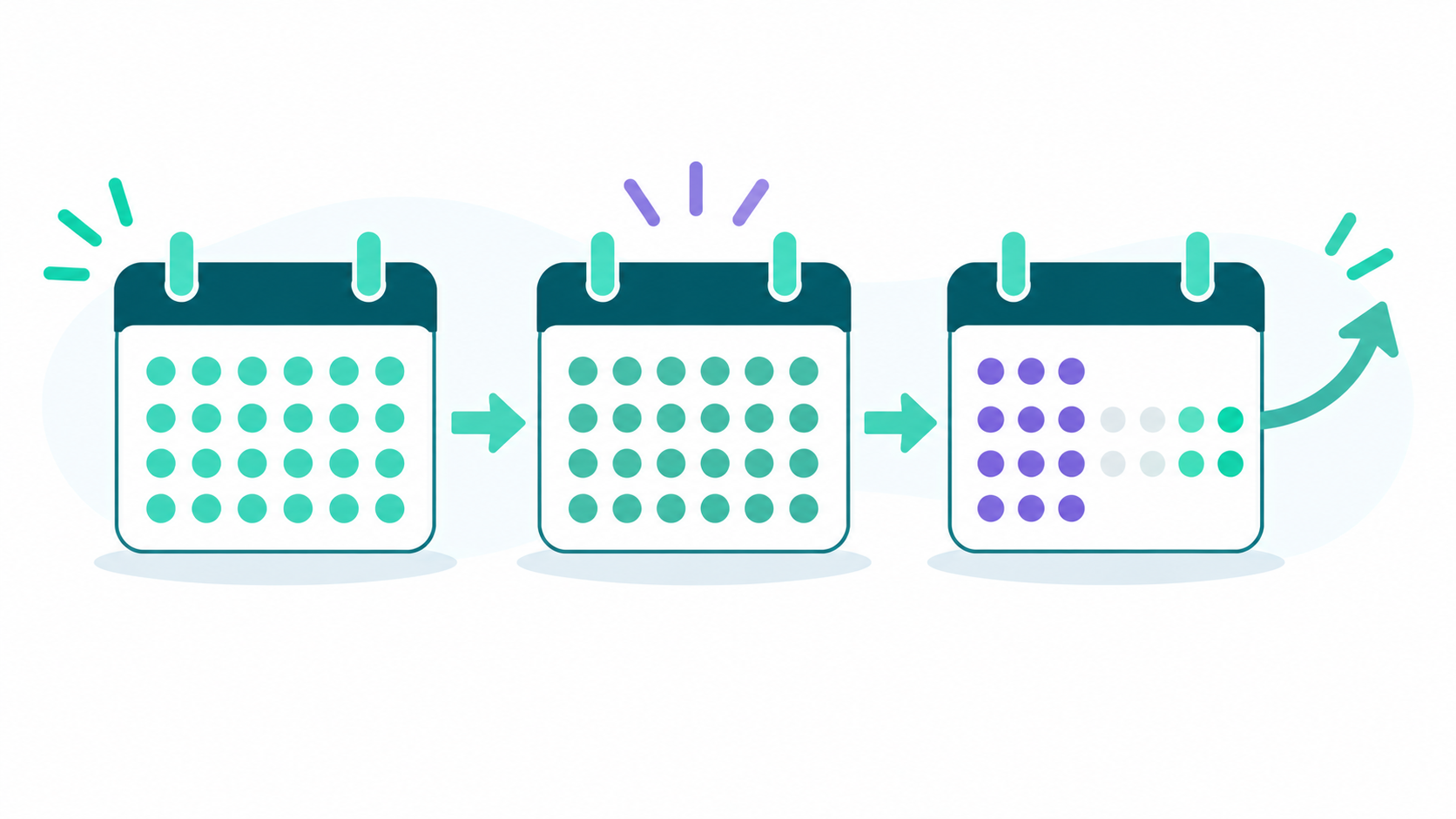
Budgets tend to break around month three because three things converge. Your first month was never a typical month, your numbers were probably too low from the beginning, and by month three the first irregular expense has arrived and landed on a plan that had no room for it.
None of that is a discipline problem, which is why trying harder rarely fixes it. The failure is structural, and once you can see the structure you can build around it.
Why month three specifically?
Because month one is atypical, month two runs on novelty, and month three is the first month where you're operating on a plan built from bad data with no motivation left to carry it.
Look at what each month actually contains.
Month one has setup costs and heightened attention. You're logging everything, you're interested in the numbers, and you're probably spending slightly differently just because you're watching. Whatever that month produced, it isn't your baseline.
Month two runs on the residual energy of starting something. Novelty is doing real work here, and it's a finite resource. You're also comparing against month one, which was distorted.
Month three is where the bill arrives. Car registration, an insurance premium, a quarterly water bill, a dental visit, a birthday, a repair. Something that wasn't in the first two months shows up, blows a category, and the whole plan suddenly looks wrong rather than incomplete.
What actually goes wrong?
Six things, and most budgets that fail hit at least three of them.
The numbers were too low from the start
This is the one almost nobody catches, and there's good research on it. Gülden Ülkümen, Manoj Thomas, and Vicki Morwitz found, in work published in the Journal of Consumer Research, that budgets people plan for the coming month land well below what they actually record spending, while annual estimates come considerably closer to reality.
The reason is that a monthly frame doesn't prompt you to think about exceptional expenses. When you plan a month, you picture a normal one. When you plan a year, the unusual stuff comes to mind, because a year obviously contains birthdays and repairs and dentists. So a budget built one month at a time is systematically optimistic, and month three is roughly when the optimism runs out.
The irregular expenses were never in the plan
Most people build a budget from one month of data, and one month cannot contain a quarterly, semiannual, or annual cost. Insurance premiums, registration and inspection, property taxes, annual subscriptions, medical visits, and gifts all live outside a single month's view.
Add them up and they're substantial. A household with $2,400 in genuinely annual costs is carrying $200 a month that never appeared in the budget, and it doesn't announce itself until one of them lands.
Categorization turned into a chore
The setup enthusiasm that produced 24 detailed categories in week one becomes a weekly sorting task by week ten. Most people who quit budgeting quit at the categorization step rather than the analysis step, and the more granular the initial structure, the faster that happens.
The novelty wore off before the habit formed
New behaviors run on deliberate effort until they become automatic, and that transition takes longer than the motivation lasts. USC psychologist Wendy Wood's research found that roughly 43 percent of daily behavior is repeated in the same context, typically while thinking about something else, but a tracking habit only gets there after it's been anchored to a consistent cue for a while.
Decay is well documented more broadly, too. A meta-analysis of 168 papers by Fernandes, Lynch, and Netemeyer found that financial education interventions had effects that decayed substantially over time, becoming negligible around 20 months out. Enthusiasm behaves the same way, just faster.
Nothing visible has happened yet
Three months in, your savings balance has probably moved a little, your debt has moved a little, and neither change is dramatic enough to feel like a reward. Meanwhile you've done twelve weeks of logging.
Research by Kellogg professors David Gal and Blake McShane found that closing debt accounts predicted successful debt elimination independent of the dollar amounts involved. What sustains effort is a visible completed win, and most budgets are designed to deliver their first one somewhere around month nine.
One bad month reads as total failure
You overspend in a category, the plan is broken, and the reasonable response would be to adjust the number. The common response is to stop entirely, because a partially broken system feels worse than no system.
There's a well documented pattern in self-regulation research where a single lapse triggers abandonment of the whole effort rather than a correction. Financial avoidance follows the same shape, and it compounds. Bankrate's research found that people who say money negatively affects their mental health are three times more likely to have paid a bill late in the past month than those who don't, at 22 percent versus 7 percent. Avoiding the numbers produces the outcome that makes the numbers worse.
How do you fix a budget that's already broken?
Revise it, don't restart it. Restarting throws away the only genuinely valuable thing you've produced, which is two or three months of real data about your own spending.
Five moves, in order.
Rebuild from your actuals, not your intentions
Pull up your last three months and set each category to what you actually spent rather than what you meant to. If groceries ran $610, $665, and $720, budget $700, not $500. A budget you miss every month stops functioning as a signal and starts functioning as a reminder that you're failing.
Lucky Friday lets you select any past month or year, so putting three months side by side to find real averages takes a few minutes rather than an archaeology session.
Add the irregular expenses as monthly amounts
List every cost that arrives less often than monthly, total the annual figure, divide by twelve, and create a category for it. Car maintenance, insurance, medical, gifts, home repairs, annual subscriptions.
This single change prevents most month-three collapses, because it converts a shock into a line item. The money accumulates quietly and the bill stops being an event.
Cut your categories
If sorting transactions takes more than five minutes a week, you have too many. Collapse anything you're not making decisions about. Twelve to fifteen categories with subcategories under the two or three that genuinely need detail beats twenty-four flat ones you resent.
Category rules help here too. Set a rule once per frequent merchant so those transactions file themselves, and the weekly task shrinks to reviewing exceptions.
Automate one transfer
This is the highest return change on the list. Set one automatic transfer for the day after payday, sized to what you could manage in your tightest recent month, and let it run regardless of how the tracking is going.
The reason it matters is that automation makes progress independent of your attention. Thaler and Benartzi's Save More Tomorrow work, along with the broader auto-enrollment literature, points the same direction: defaults outperform intentions consistently. Our piece on why most budgeting apps never move your savings rate covers this in more depth, and the short version is that tracking diagnoses while the transfer treats.
Change the review cadence
Once a month, fifteen minutes, three questions: what moved, what's new, and what am I paying for that I stopped using. Weekly reviews produce noise, since a week is too short to show a trend, and noise is discouraging.
How do you build one that survives month three in the first place?
Four things at setup, and none of them add much work.
Build from three months of history rather than one, since a single month can't contain your irregular costs and will produce a budget that's wrong by design.
Include a miscellaneous or buffer line of $100 to $200. Not because you can't predict spending, but because you can't predict which unpredictable thing will happen. A buffer converts a surprise from a plan-breaker into an absorbed cost.
Budget for a miss explicitly. Decide in advance that you'll overspend some category in some month, and that when you do, the response is to adjust the number rather than abandon the system. Naming that in advance removes most of its power.
Write the trigger down. Research by Gollwitzer and Sheeran covering 94 studies found that specifying when, where, and how you'll act produces a medium to large improvement in follow-through, with a particularly strong effect on preventing derailment once a goal is already underway. That last part is exactly the month three problem. So "on the first Sunday of the month I review for fifteen minutes" works, and "I'll keep on top of it" doesn't.
What should you do the month you blow it?
Log it anyway. That's the entire discipline, and it's the thing that separates people who recover from people who quit.
Three rules make recovery reliable.
Record the overspending accurately rather than fudging it or skipping the month. The month you overspent is the most informative month you have, and deleting it means learning nothing.
Don't try to make up the shortfall next month. Cutting next month's grocery budget to compensate for this month's overage usually causes a second miss, and two consecutive failures is where people stop for good.
Adopt a one-miss rule. A missed month is one missed month, not a broken system. The system is broken when you stop looking, not when a number comes in high.
And if you've stopped opening the app for a few weeks, the way back in is to look at one category rather than the whole thing. Reengaging with a single number is much easier than facing a full reconciliation, and it usually restarts the habit.
Does your setup help or hurt?
An app that demands twenty minutes a week will lose to one that demands five, regardless of which has better features. The maintenance cost of your setup is the variable that determines whether you're still doing this in month six.
A few things reduce that cost meaningfully. Category rules so transactions sort themselves. A category structure that matches decisions you'd actually make rather than one built for someone else. Lucky Friday lets you create unlimited custom categories and subcategories with your own icons and colors, which matters both ways here: you can build the detail where it's useful and keep everything else simple. All of that sits on the permanently free tier, with no category limits and no credit card required, so a setup that isn't working can be rebuilt without any sunk cost.
The annual budget view is worth using for exactly the reason the research suggests. Since monthly estimates run systematically low and annual thinking surfaces the exceptional costs, toggling to the yearly figure is what catches the expenses that break month three.
Planned versus actual tracking is what makes revision possible rather than guesswork, since it shows the gap between what you budgeted and what happened per category. And if entering transactions by hand is what's killing your consistency, bank sync through Plaid is available on the premium plan, covering more than 11,000 institutions. Manual entry stays free if you prefer the awareness it creates.
One closing thought. If the first thing you built didn't survive, that's the normal path rather than a personal failure. Almost nobody's first budget is the one they keep, because a first budget is necessarily built from guesses and a second one is built from data. Month three isn't where budgeting fails. It's where the guessing version ends and the real one starts, and our guide to starting an emergency fund when you're already behind is a reasonable place to point the money once it does.
Common Questions About Budgets Failing
Why do most budgets fail?
Usually because the numbers were too optimistic and the irregular expenses were missing. Research published in the Journal of Consumer Research found that people's monthly budget estimates land well below what they actually spend, because a monthly frame doesn't prompt you to think about exceptional costs. Build from three months of real data instead of one, and add annual expenses as monthly amounts.
How long does it take for budgeting to become a habit?
Longer than motivation typically lasts, which is the core problem. Research on habit formation shows the timeline varies widely by person and behavior, and what matters most is anchoring the action to a consistent cue. Attaching the review to a fixed date and automating at least one transfer bridges the gap between enthusiasm fading and the habit taking hold.
What should I do if I overspend my budget?
Record it accurately, adjust the category for next month, and don't try to make up the shortfall. Cutting next month to compensate usually causes a second miss, and two consecutive failures is where most people quit. A missed month is one missed month, not a broken system.
How many budget categories should I have?
Enough that each one maps to a decision you could act on, usually twelve to fifteen with subcategories under the two or three that need detail. If sorting transactions takes more than five minutes a week, you have too many, since categorization is where most people abandon budgeting rather than at the analysis stage.
Should I start over if my budget isn't working?
Revise rather than restart. The two or three months of data you've collected is the most valuable thing you have, and starting fresh throws it away along with the reason your first attempt was wrong. Reset your category amounts to what you actually spent and add the irregular expenses you missed.
Sources
Ülkümen, Gülden, Manoj Thomas, and Vicki G. Morwitz. "Will I Spend More in 12 Months or a Year? The Effect of Ease of Estimation and Confidence on Budget Estimates." Journal of Consumer Research, vol. 35, no. 2, 2008, pp. 245 to 256. https://academic.oup.com/jcr/article-abstract/35/2/245/1806120
Gollwitzer, Peter M., and Paschal Sheeran. "Implementation Intentions and Goal Achievement: A Meta-Analysis of Effects and Processes." Advances in Experimental Social Psychology, vol. 38, 2006. https://cancercontrol.cancer.gov/brp/research/constructs/implementation-intentions
Fernandes, Daniel, John G. Lynch Jr., and Richard G. Netemeyer. "Financial Literacy, Financial Education, and Downstream Financial Behaviors." Management Science, vol. 60, no. 8, 2014. https://papers.ssrn.com/sol3/papers.cfm?abstract_id=2333898
Wood, Wendy, and David Rünger. "Psychology of Habit." Annual Review of Psychology, vol. 67, 2016. https://pubmed.ncbi.nlm.nih.gov/26361052/
Kellogg School of Management, Northwestern University, on Gal and McShane's research into visible progress and debt elimination. https://www.kellogg.northwestern.edu/news_articles/2012/snowball-approach.aspx
Heath, Chip, and Jack B. Soll. "Mental Budgeting and Consumer Decisions." Journal of Consumer Research, vol. 23, no. 1, 1996. https://academic.oup.com/jcr/article-abstract/23/1/40/1841483
Bankrate. "Survey: 43% of Americans say money is negatively impacting their mental health." https://www.bankrate.com/banking/money-and-mental-health-survey/
Thaler, Richard H., and Shlomo Benartzi. "Save More Tomorrow: Using Behavioral Economics to Increase Employee Saving." Journal of Political Economy, vol. 112, no. S1, 2004. https://papers.ssrn.com/sol3/papers.cfm?abstract_id=489693