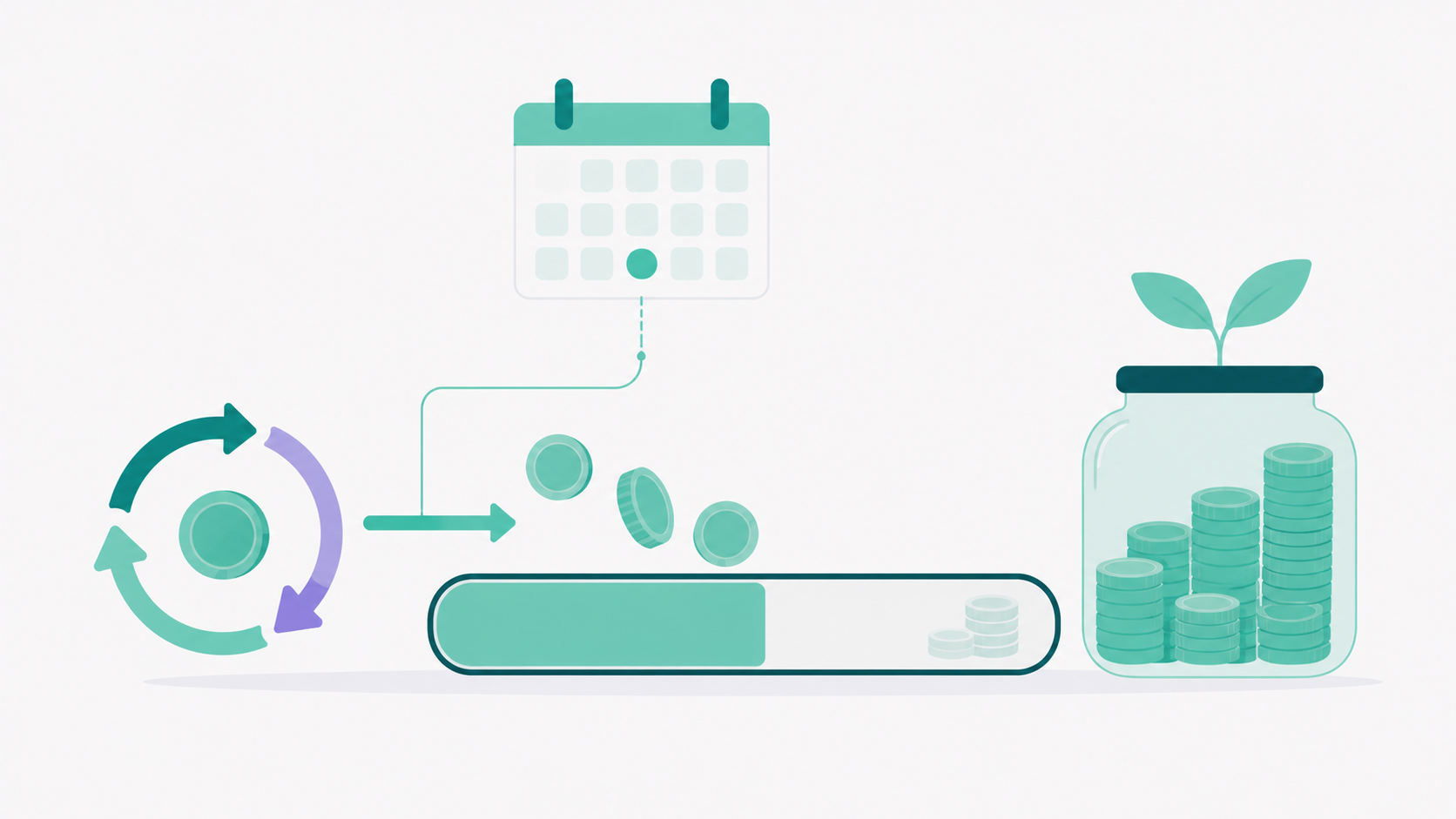
Most savings goals fail because a goal is an intention, and intentions don't survive a normal month. "Save $5,000 this year" specifies an outcome but not a single action, so the decision to save gets made fresh every time money moves, and roughly 24 of those decisions a year have to go your way.
The research on this is unusually clear about what closes the gap. Gollwitzer and Sheeran's meta-analysis of 94 studies found that people who specified the when, where, and how of a goal in advance, rather than just holding the goal, saw a medium to large improvement in actually reaching it. The fix isn't more motivation. It's converting a goal into a mechanism that runs whether you're motivated or not.
Why do savings goals fail?
They fail at the point of execution, not the point of intention. People are generally accurate about how much they want to save and wildly optimistic about how many times they'll choose to do it. Here are the five failure modes worth recognizing, because each has a different fix.
The goal has no trigger attached to it
"I'll save what's left at the end of the month" is the single most common savings plan and it has a reliable outcome, which is zero. There's no leftover, because spending expands to fill whatever's available. A goal without a specific moment attached is a goal that gets postponed indefinitely, and that's exactly the failure mode implementation intentions were designed to solve.
The target is far enough away to feel imaginary
Three to six months of expenses is the standard advice. For a household spending $3,500 a month, that's between $10,500 and $21,000, and at $100 a month it takes between nine and 17 years. Nobody sustains a habit for nine years without an intermediate win, so the goal gets classified as impossible and quietly dropped. The number isn't wrong as a destination, it's just useless as a next step.
The money has nowhere separate to live
Savings that sit in checking get spent, not through weakness but because the balance reads as available. Without a separate home and a label, the money doesn't feel different from the money that pays for groceries, so it eventually pays for groceries.
One bad month gets read as total failure
You miss February because of a car repair. The plan feels broken, so you stop, and the stopping does far more damage than the missed month did. This is the pattern that turns a small setback into abandoning the goal entirely, and it's the reason a plan with built in slack outperforms a stricter one.
The plan assumes a month you've never actually had
Most savings targets get set against an idealized month with no birthdays, no copays, no car trouble, and no annual insurance bill. That month doesn't exist. Set the target against your typical month instead and it survives; set it against your best month and it fails in week six.
What does the research say actually works?
Two things, consistently: writing an if then plan that specifies exactly when the saving happens, and removing the decision from your hands entirely through automation.
On the first, Gollwitzer and Sheeran's 2006 meta-analysis covered 94 independent tests and found that forming implementation intentions produced a medium to large effect on goal attainment, with an even stronger effect specifically on preventing derailment once a goal was underway. The format is simple: "If it's the 2nd of the month, then I transfer $75 to savings." That sentence outperforms "I'll try to save more" by a wide margin, and it costs nothing to write.
On the second, the best known example is the Save More Tomorrow program from Richard Thaler and Shlomo Benartzi. Employees pre committed to putting part of future raises into retirement savings, and among participants in the original implementation, average savings rates went from 3.5 percent to 13.6 percent over 40 months, with 80 percent still enrolled after four raises. Worth noting that the Department of Labor's evidence review rated the causal strength of that specific study as low, since participants self selected. But the underlying principle, that defaults and automation beat willpower, is supported by a much broader body of auto enrollment research, and it was strong enough that Congress built auto escalation into federal retirement law.
The takeaway for a personal savings goal is the same either way. Every decision you remove is a decision that can't go wrong.
How do you turn a savings goal into something that actually runs?
Give it a name, a number sized to your worst month, a date, and a separate place to live. Those four elements convert a wish into a mechanism, and the whole setup takes about 20 minutes.
Work through it in this order.
Name the goal specifically
"Emergency fund" beats "savings," and "car repair fund" beats "emergency fund" if a car repair is what you're actually worried about. Specific labels resist raiding, because spending a labeled fund on something else requires a conscious override rather than a shrug.
Size it to your worst recent month, not your average
Look at your last six months and find the tightest one. Set the monthly amount at something you could have managed even in that month. If that number is $40, the number is $40. A $40 transfer that runs 12 times beats a $200 transfer that runs three times, and it beats it by more than double.
Attach it to a specific date
Pick the day after payday, not the end of the month. Write the if then sentence down somewhere you'll see it. If you can set an automatic transfer at your bank, do that instead, since the automated version doesn't depend on you remembering anything.
Break the target into tiers
Rather than one distant number, set three: a first tier around $500, a second at $1,000, and a third at one month of expenses. Each one is a real accomplishment and each buys you something specific. Our guide to starting an emergency fund when you're already behind walks through this staged approach in detail, including how to build the first tier without waiting for your income to change.
Give it a home with a little friction
A separate savings account is enough. Not so far away that you can't reach it in a genuine emergency, but far enough that it doesn't show up in your checking balance and get spent by accident.
How does a budgeting app actually help?
It does three specific things: it shows you where the money could come from, it makes progress visible enough to sustain, and it catches the month a goal quietly stops. What it can't do is create money that isn't there, which is worth being straight about.
It finds the money
Most people can identify one or two categories that are bigger than they realized, and that's usually where the first $50 to $100 a month comes from. The trick is granularity: a broad category like "Food" hides everything inside it, while separate subcategories for groceries, delivery, and coffee show you which behavior is actually moving. Lucky Friday lets you create unlimited custom categories and subcategories with your own names, icons, and colors, so the structure matches how you actually spend rather than a preset list built for someone else. That's all on the permanently free tier, with no category limits and no credit card.
It makes the goal a line item instead of a hope
Create a category for the goal itself and set a planned amount against it. Planned versus actual tracking means the goal shows up in the same view as everything else you budget for, which reframes saving as a bill you owe yourself rather than a residual. Watching a category fill month over month is also more motivating than watching a bank balance, because the balance moves for a dozen unrelated reasons and the category doesn't.
It shows direction, which is what predicts failure
The month a goal starts failing usually looks fine in isolation. What gives it away is direction: three months of declining contributions, or a category that's crept up and absorbed the money. Being able to pull up any past month or year and read the trend is what turns a review into a signal rather than a snapshot. Category rules help keep that review short, since transactions matching a keyword file themselves instead of needing manual sorting. If you'd rather transactions import on their own rather than entering them by hand, bank sync through Plaid is available on the premium plan.
What an app genuinely can't do
An app doesn't move money for you, and it doesn't create slack in a budget that doesn't have any. Tracking is diagnostic, not therapeutic, and plenty of people track diligently for a year without their savings changing at all. We wrote about exactly that in our piece on why most budgeting apps never move your savings rate, and the short version is that visibility only converts into savings when it's paired with an actual transfer that happens without your involvement. The app tells you what to automate. The automation does the work.
One more thing that matters if you're going to look honestly at your own numbers. Lucky Friday never sends your financial data to AI models, never sells it to third parties, and never uses it for advertising. It runs on iOS and web, and it was built by a solo founder over about two and a half years, which is why the free tier can stay free without ads or data sales.
What if there genuinely isn't anything left to save?
Then the honest answer is that the goal needs resizing, not more discipline. Set the amount at $20 a month if that's what fits, because crossing the first meaningful threshold matters far more than the pace at which you cross it.
For context on how common this is, Bankrate's January 2026 Emergency Savings Report found that only 30 percent of Americans would cover a $1,000 emergency from savings, and a third said they'd go into debt to handle it. The Federal Reserve's 2025 SHED found that 30 percent of adults couldn't cover three months of expenses by any means at all, including borrowing. If your budget has no room in it, you are in a large group, and the useful move is to work on the income and fixed cost side rather than blaming a spending habit that may not be the problem.
If your income varies week to week, which makes a fixed monthly savings target genuinely harder to hold, our approach to budgeting on an irregular income covers setting amounts against your lowest recent period instead of your average.
Common Questions About Why Savings Goals Fail
Why can't I stick to a savings goal?
Usually because the goal specifies an outcome without specifying an action. Research on implementation intentions found that people who write down exactly when and how they'll act are substantially more likely to follow through than people holding the same goal without a plan. Attaching the transfer to a specific date, or automating it entirely, removes the repeated decision that keeps failing.
How much should I save each month?
Enough that you could have managed it during your tightest month in the last six, which is often less than standard advice suggests. A $50 monthly transfer you maintain all year beats a $250 target you abandon in March. Start there and increase the amount only after three consecutive months without a miss.
Is it better to save automatically or manually?
Automatically, in almost every case, because automation removes the decision rather than relying on you to make it correctly 12 times a year. The Save More Tomorrow research and the broader auto enrollment literature both point the same direction: defaults outperform intentions. Manual transfers work if you attach them to a specific date and treat them like a bill.
Can a budgeting app really help me save money?
It helps by showing where money is going, turning the goal into a tracked line item, and revealing when contributions start slipping. What it can't do is create room in a budget that doesn't have any, or move the money for you. The combination that works is an app for visibility plus an automatic transfer for execution.
What should I do after I miss a month?
Restart at the same amount and don't try to make up the shortfall, since doubling up next month usually causes a second miss. One missed transfer costs you that transfer, while quitting costs you every remaining one for the year. Building deliberate slack into the plan, like a target you can hit in a bad month, prevents most misses in the first place.
Sources
Gollwitzer, Peter M., and Paschal Sheeran. "Implementation Intentions and Goal Achievement: A Meta-Analysis of Effects and Processes." Advances in Experimental Social Psychology, vol. 38, 2006, pp. 69 to 119. https://cancercontrol.cancer.gov/brp/research/constructs/implementation-intentions
Thaler, Richard H., and Shlomo Benartzi. "Save More Tomorrow: Using Behavioral Economics to Increase Employee Saving." Journal of Political Economy, vol. 112, no. S1, 2004, pp. S164 to S187. https://papers.ssrn.com/sol3/papers.cfm?abstract_id=489693
U.S. Department of Labor, CLEAR evidence review of Thaler and Benartzi (2004). https://clear.dol.gov/study/save-more-tomorrow%E2%84%A2-using-behavioral-economics-increase-employee-saving-thaler-benartzi-2004
Bankrate. "Just 30% of Americans Say They Would Pay an Emergency Expense of $1,000 From Savings." January 21, 2026. https://www.bankrate.com/press-releases/just-30-of-americans-say-they-would-pay-an-emergency-expense-of-1000-from-savings/
Board of Governors of the Federal Reserve System. "Economic Well-Being of U.S. Households in 2025," Savings and Investments section, May 2026. https://www.federalreserve.gov/publications/2026-economic-well-being-of-us-households-in-2025-savings-investments.htm