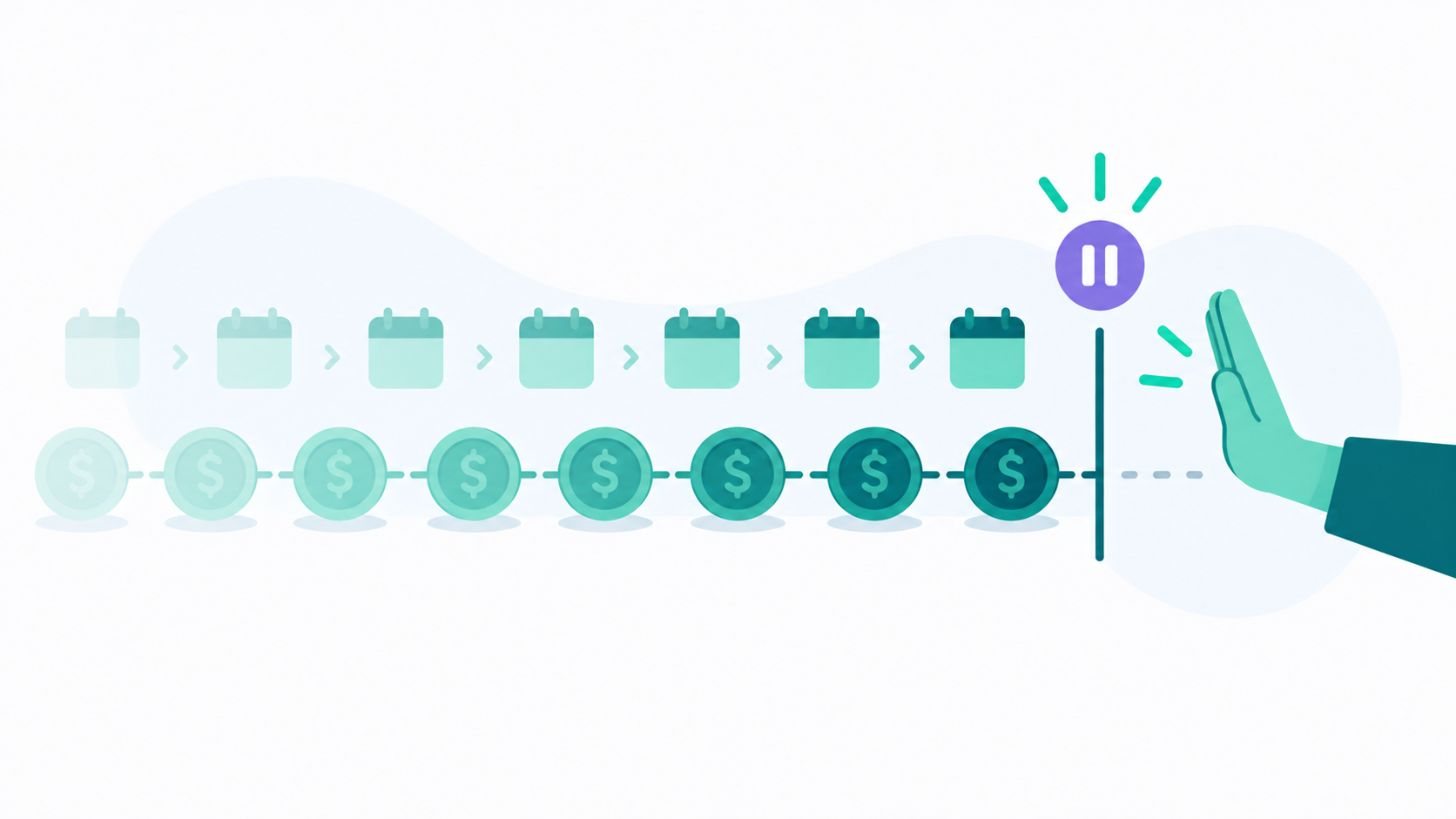
Subscription charges are easy to ignore because after the first payment, there's no decision left to make. You chose once, months or years ago, and every renewal since has been the result of doing nothing. Inaction is not a decision your brain registers, so the charge never surfaces for review.
There's unusually clean evidence for this. Economists studying data from a large payment card network used card replacements, the kind that happen when a card expires, as a natural experiment. Because a replaced card forces subscribers to make an active choice, the researchers could separate genuine preference from pure inertia. Retention dropped sharply in the month of replacement, which means a substantial share of subscriptions were being sustained by nothing more than the absence of a prompt.
Why don't you notice recurring charges?
Because renewal is the default, and defaults are extraordinarily powerful. The subscription continues unless you actively intervene, and the system is designed so that intervening requires deliberate effort while continuing requires none at all.
The card replacement research, published by Liran Einav, Ben Klopack, and Neale Mahoney in the American Economic Review, quantified how much of subscription revenue depends on this. Studying ten subscription services, they estimated inattention parameters implying low rates of active subscription management, and found that consumer inattention significantly boosts company revenues. In plain terms, a meaningful portion of what people pay for subscriptions is money they'd stop paying if anything ever asked them.
That reframes the whole issue. The problem isn't that you decided to keep paying for something you don't use. It's that you never decided anything, and nothing in the system was ever going to make you.
What's actually happening in your head?
Four mechanisms stack on top of each other, and each one alone would be enough to make a small recurring charge invisible.
There's no moment of paying
Behavioral economists talk about the pain of paying, the small friction that makes a purchase register. A subscription has one such moment, at signup, and then never again. The card is on file, the charge posts, and no part of the process requires your attention.
The amount sits below your noticing threshold
Human perception works on relative differences rather than absolute ones. A $14 charge against a month of ordinary transactions is genuinely hard to detect, not because you're careless but because it's small relative to everything around it. That's why subscriptions cluster in the $8 to $20 range, which is comfortably below where most people's attention triggers.
Your brain files it as a fixed cost
Research on mental budgeting by Chip Heath and Jack Soll found that people run informal internal budgets by category, and once something is filed as a fixed obligation it stops being subject to review. Rent gets that treatment appropriately. A streaming service that quietly joined the same mental category doesn't deserve it, but the filing already happened.
Canceling costs effort now for a benefit later
Present bias does the rest. Canceling takes ten minutes today and saves $17 next month, which is exactly the shape of task humans reliably postpone. Multiply by five subscriptions and the postponement can last years.
Do people know this about themselves?
Partly, and the research on that is more interesting than you'd expect. A field experiment with two million readers of a European newspaper found that consumers actively avoid auto-renewing contracts because they anticipate their own future inertia.
The study, by Klaus Miller, Navdeep Sahni, and Avner Strulov-Shlain, offered promotional subscriptions that ended either in automatic renewal at full price or in automatic cancellation. Offering the auto-renewing version lowered subscription take-up by 24 percent, and readers who received the auto-renewal offer were about 9 percent less likely to sign up at any point during the following two years.
So people understand something real about themselves. They know that once they're in, they probably won't get out, and they price that in at the decision point. What the researchers also found is that consumers significantly underestimate how strong their inertia actually is.
That combination is worth sitting with. You're right to be suspicious of auto-renewal, and you're probably still underestimating how long you'll stay subscribed once you are.
This isn't new, either. One of the earliest findings in this literature came from a study of gym memberships by Stefano DellaVigna and Ulrike Malmendier, which documented substantial cancellation lags among members on automatically renewing contracts. People kept paying for gyms they'd stopped attending, for months.
How much does inattention actually cost?
More than people estimate, and the gap between estimate and reality is the clearest evidence of the effect. A survey commissioned by C+R Research and covered by CNBC found consumers guessed they spent about $86 a month on subscriptions, while walking through category by category produced an actual average of $219. That's a gap of $133 a month, roughly $1,600 a year, and the same research found 42 percent of people were still paying for something they no longer used.
More recent data suggests the problem isn't shrinking. Self Financial's 2026 survey found nearly 60 percent of people have at least one unused subscription in a typical month, averaging 2.6 unused subscriptions, up from 54.9 percent and 0.8 the year before. And Deloitte's 2026 Digital Media Trends survey put the average subscribing household at four streaming services costing $69 a month, or $828 a year, before counting anything outside video.
What's the design layer?
Friction is deliberately asymmetric. Signing up takes one click and canceling frequently takes considerably more, and regulators have started treating that gap as a legal problem rather than a design preference.
The clearest example is the Amazon Prime case. In September 2025, Amazon agreed to a $2.5 billion settlement with the Federal Trade Commission, comprising a $1 billion civil penalty and $1.5 billion in refunds to roughly 35 million customers, over allegations it used manipulative interface designs to enroll people in auto-renewing subscriptions and made cancellation unnecessarily difficult. The settlement requires a clearly labeled decline option, disclosure of material terms before billing information is collected, and cancellation through the same medium used to sign up.
On the regulatory side, be careful what you rely on. The FTC's click-to-cancel rule, which would have required cancellation to be as simple as signup, was finalized in 2024 and then vacated by a federal appeals court in 2025 over procedural issues with the rulemaking. It is not currently in force. The FTC restarted the process in early 2026 and continues bringing enforcement actions under existing law, but none of that helps you this month.
Assume the friction is there by design and build your own countermeasure.
How do you make subscriptions visible again?
Recreate the card replacement effect on purpose. The research shows that forcing an active choice is what produces cancellations, so schedule a moment that forces one.
Six things, in rough order of return.
Run a forced-choice audit twice a year
Put two dates in your calendar, then on each one go through every recurring charge and make an explicit keep-or-cancel decision. Not a review, a decision. The difference matters, because reviewing lets you default to keeping while deciding requires an answer.
Scan three months of statements, not one
Annual and quarterly charges won't appear in a single month, and those are precisely the ones people forget hardest. A yearly charge that renewed in March is invisible in a September review of last month's spending.
Convert every monthly figure to annual
This is the reframe that changes behavior. Seventeen dollars a month is forgettable. Two hundred and four dollars a year is a decision you have an opinion about. Multiply everything by twelve before you decide anything.
Use a strict 60-day rule
If you haven't opened it in 60 days, cancel it. You can always resubscribe, and the cost of being wrong is one month's fee, which is far smaller than the cost of another year of paying for nothing.
Calendar the cancellation date the day you subscribe
Especially for free trials. The single most effective free-trial habit is setting a reminder two days before it converts, at the moment you sign up, when you're already thinking about it.
Watch the merchant names
Charges frequently post under a parent company name you don't recognize. If you can't identify a recurring charge, search the exact merchant string before assuming it's legitimate, because unrecognized charges are where both forgotten subscriptions and actual fraud live.
How do you track them so it doesn't rebuild?
Give subscriptions their own category with a subcategory per service, and look at the annual total rather than the monthly one.
That structure is what makes the drift visible. Most budgeting apps offer a preset list where subscriptions scatter across entertainment, software, and utilities, so a new one can appear without anything looking different. Lucky Friday lets you create unlimited custom categories and subcategories with your own icons and colors, so you can build a Subscriptions parent with each service underneath it and see both the total and the composition. When something new joins the list, it's obvious immediately rather than at the end of a year. All of that is on the permanently free tier, with no category limits and no credit card required.
Two features do most of the work for this particular job. Category rules let you set a keyword once per merchant so those charges file themselves rather than needing manual sorting every month, which keeps the twice-yearly audit short enough that you'll actually do it. And the monthly and annual toggle is the one that changes decisions, for the reason described above. If you'd rather have transactions import automatically rather than entering them by hand, bank sync through Plaid is available on the premium plan, covering more than 11,000 institutions.
Then assign whatever you free up on the same day. Money without a destination reabsorbs into ordinary spending within about six weeks, which is roughly how long it takes to forget you canceled anything. Our guide to starting an emergency fund when you're already behind covers where to send it, and if you've tracked spending before without your savings changing, our piece on why most budgeting apps never move your savings rate explains why visibility alone isn't enough.
One closing thought. The research here should be reassuring rather than accusatory. A subscription you forgot about isn't evidence of carelessness, it's evidence that a system was built to not require your attention, and it worked. Building one deliberate moment of attention twice a year is a proportionate response, and it's roughly all that's needed.
Common Questions About Subscription Charges
Why do people keep paying for subscriptions they don't use?
Because renewal is automatic and canceling requires deliberate action, so inaction sustains the charge indefinitely. Research using payment card replacements as a natural experiment found retention drops sharply in the month a card is replaced, because that forces subscribers to make an active choice. A large share of subscription revenue depends on customers never being asked.
How much do people spend on subscriptions without realizing?
One widely cited survey found consumers estimated about $86 a month while their actual average was $219, a gap of roughly $133 monthly or $1,600 a year. More recent research found nearly 60 percent of people have at least one unused subscription in a typical month, averaging 2.6 unused services.
How often should I audit my subscriptions?
Twice a year is enough if you make it a forced decision rather than a review. Scan three months of statements each time, since annual and quarterly charges won't appear in a single month, and convert every monthly figure to an annual one before deciding. The annual number is what actually prompts action.
Is there a law requiring easy subscription cancellation?
Not currently at the federal level. The FTC's click-to-cancel rule was finalized in 2024 and vacated by a federal appeals court in 2025 over procedural issues, so it never took effect. The FTC restarted the rulemaking in early 2026 and continues enforcing under existing consumer protection law, including a $2.5 billion settlement with Amazon in September 2025.
Do people know they'll forget to cancel?
Partly. A field experiment with two million newspaper readers found that offering auto-renewing contracts lowered subscription take-up by 24 percent, meaning consumers actively avoid arrangements their own inertia would trap them in. The same research found people significantly underestimate how strong that inertia actually is.
Sources
Einav, Liran, Benjamin Klopack, and Neale Mahoney. "Selling Subscriptions." American Economic Review, vol. 115, no. 5, 2025, pp. 1650 to 1671. https://web.stanford.edu/~leinav/pubs/AER2025.pdf
Einav, Liran, Benjamin Klopack, and Neale Mahoney. "Selling Subscriptions." NBER Working Paper 31547. https://www.nber.org/system/files/working_papers/w31547/w31547.pdf
Miller, Klaus M., Navdeep S. Sahni, and Avner Strulov-Shlain. "Sophisticated Consumers with Inertia: Long-Term Implications from a Large-Scale Field Experiment." Becker Friedman Institute, University of Chicago. https://bfi.uchicago.edu/insight/research-summary/sophisticated-consumers-with-inertia-long-term-implications-from-a-large-scale-field-experiment/
Chicago Booth Review. "Why locking in subscribers is bad business." https://www.chicagobooth.edu/review/why-locking-subscribers-bad-business
Heath, Chip, and Jack B. Soll. "Mental Budgeting and Consumer Decisions." Journal of Consumer Research, vol. 23, no. 1, 1996. https://academic.oup.com/jcr/article-abstract/23/1/40/1841483
CNBC, reporting research commissioned by C+R Research. "Consumers Spend an Average $133 More Each Month on Subscriptions Than They Realize." https://www.cnbc.com/2022/06/02/consumers-spend-133-more-monthly-on-subscriptions-than-they-realize.html
Time. "Amazon Reaches $2.5 Billion Settlement Over 'Deceptive' Prime Program." https://time.com/7320708/amazon-prime-ftc-lawsuit-settlement-membership-subscription-cancel-dark-patterns/
Goodwin. "FTC's Click-to-Cancel Rule Gets New Life As FTC's Enforcement Wave Continues to Target Negative-Option Sellers." February 2026. https://www.goodwinlaw.com/en/insights/publications/2026/02/alerts-practices-ba-ftcs-click-to-cancel-rule-gets-new-life